Skip to main content Skip to main navigation
Stanford University School of Education Home
  • SUSE Directory
  • Library
  • AXESS
  • Make a Gift
  • Stanford Home
  • About SUSE
  • Admissions
  • Academics
  • Faculty & Research
  • News & Events
  • Knowledge at Work
Photo of campus architecture
Home » Faculty & Research » Faculty Profiles » Schwartz, Dan

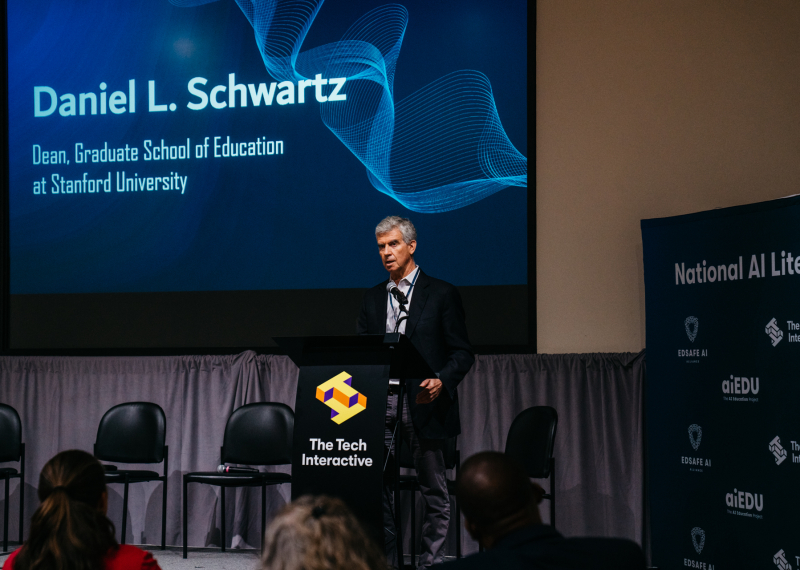
Schwartz, Dan

Academic Title

Professor

Contact Info

Phone: 
(650) 736-1514
Email: 
daniel.schwartz@stanford.edu
Office Location: 
CE 222
Personal Webpage: 
http://www.stanford.edu/people/Daniel.Schwartz

Admin. Support

Kelsey Fisher

Program Affiliations

DAPS
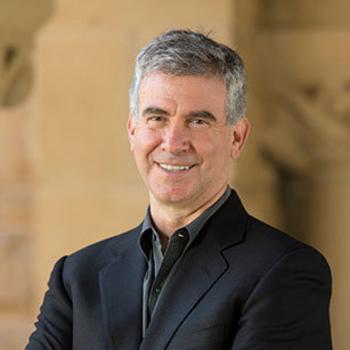
Dan Schwartz

Research

Research Summary: 

A member of the SUSE faculty since 2000, Dr. Schwartz studies student understanding and representation and the ways that technology can facilitate learning. He works at the intersection of cognitive science, computer science, and education, examining cognition and instruction in individual, cross-cultural, and technological settings. A theme throughout Dr. Schwartz's research is how people's facility for spatial thinking can inform and influence processes of learning, instruction, assessment and problem solving. He finds that new media make it possible to exploit spatial representations and activities in fundamentally new ways, offering an exciting complement to the verbal approaches that dominate educational research and practice.

Current Research: 

Instructional methods, transfer of learning and assessment, mathematical development, teachable agents, cognition, and cognitive neuroscience.

Research Interests: 
Science Education
Small Group Instruction and Interaction
Cognitive Development
Cognitive Psychology
Learning Design
Mathematical Problem-solving
Mathematics Education
Technology in Teaching and Learning

Quote

"Constructivism is a broad vision of learning; it is not just an approach to instruction. It enables us to consider students’ abilities to create new knowledge when they are outside of instruction and we no longer have control over precise instructional variables. By shifting the focus [of constructivism] to assessment, we can ask the question, “What experiences prepare students to construct knowledge in the future and in the wild?” This question is important because learning should not end once students leave the classroom and lose a teacher’s direct guidance. By creating constructivist assessments, it will be possible to identify the elements of instruction — constructivist or otherwise — that facilitate the development of continued learning."

- From "Constuctivism in an Age of Non-Constructivist Assessments" with Robb Lindgren and Sarah Lewis.

Education

  • PhD (Human Cognition and Learning), Columbia University, 1992
  • MA (Computers and Education), Columbia University, 1988
  • BA (Philosophy and Anthropology), Swarthmore College, 1979
  • Teaching Certificate, University of Southern California, 1981

Time at Stanford

Since 2000

Professor of Education

Professional Experience

Teacher of Mathematics, Kitiwanga Day School, Kitiwanga, Kenya

Teacher of Remedial Reading and Writing, John Muir Jr. High, Los Angeles, CA)

Teacher of Mathematics, Science, Reading and Language Arts, Kaltag Jr. & Sr. High Schools, Kaltag, AK

Programmer & Instructor in Lisp, C, & Assembler

Research Scientist, Learning Technology Center at Vanderbilt

Assistant and Associate Professor of Psychology and Human Development, Vanderbilt University

Courses Taught

Instructional methods, transfer of learning and assessment, mathematical development, teachable agents, cognition, and cognitive neuroscience.

Recent Publications

Schwartz, D. L., Bransford, J. D., Sears, D. L. (2005). Efficiency and innovation in transfer. In J. Mestre (Ed.), Transfer of learning from a modern multidisciplinary perspective (pp. 1 - 51). CT: Information Age Publishing.

Varma, S., McCandliss, B. D., & Schwartz, D. L. (2008). Scientific and pragmatic challenges for bridging education and neuroscience. Educational Researcher, 37(3), 140-152.

Martin, L. & Schwartz, D. L. (in press). Prospective adaptation in the use of representational tools. Cognition and Instruction.

Chase, C., Chin, D. B., Oppezzo, M., & Schwartz, D. L. (in press). Teachable agents and the protégé effect: Increasing the effort towards learning. Journal of Science Education and Technology.

Current Activities

Co-Director of the National Science Foundation, Science of Learning Center called Learning in Informal and Formal Environments.

Faculty & Research

  • Faculty Profiles
  • Faculty Research Interests
  • Faculty Centers
  • SUSE Faculty Open Positions
  • SUSE Open Archive
  • Proposal and Research Resources
  • Resources for Faculty
  • Login
Stanford University School of Education
485 Lasuen Mall, Stanford, CA 94305-3096
Tel: (650) 723-2109
Copyright 2012 Stanford University.
All rights reserved. Terms of use | Copyright Complaints
  • Site Map
  • Contact Us
  • HelpSU
  • SUSE IT
  • AXESS
  • Academic Calendar
  • Stanford Bulletin
  • Office of the Registrar
  • EDmail
  • StanfordWho
  • StanfordYou
  • Login
Connect with us on Facebook Connect with us on Twitter Connect with us on YouTube Connect with us on Flickr

Make a gift now