Aiming higher
After immigrating from Taiwan at five, Fong developed a profound appreciation for education, which she has channeled into mentoring over 50 students through Stanford Career Education. In 2026, the university honored her with a Governors' Award for her exemplary alumni service.
GSE alumna is honored for her decades of volunteer service to Stanford University.
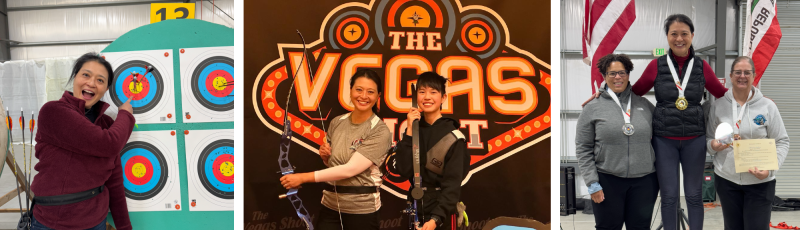
In 2021, Mo Fong sat on a bench watching her son’s archery lesson when the instructor invited her to try shooting, and so she fitted an arrow to the bow for the first time. Four years later, she had won the California State Indoor archery championships in the masters’ division.
Because Mo Fong, BS ’95, MA ’96, doesn’t do things in half-steps.
As a teenager, she volunteered at a local hospital, and by her senior year she had accrued over 1,100 volunteer hours.
At Stanford, she chose the hardest major she could find—chemical engineering—and went on to earn a master’s in education through the Stanford Teacher Education Program (STEP) and an MBA from Harvard Business School.
Now as an alumna, she volunteers for Stanford Career Education, where she has mentored more than 50 students over the past seven years—putting her in the top 1% of alumni engaging with students.
For this last contribution, Fong received a Governors’ Award in 2026, a university-wide tribute to exemplary alumni volunteer service. She was nominated by the Stanford Graduate School of Education.
“I’m so honored to be a GSE alum,” she says. “I feel just a ton of gratitude.”
A pattern of teaching
Fong immigrated to the United States from Taiwan when she was five years old, and her first-grade teacher helped her to learn English through phonics on cassette tapes. “I literally didn’t speak the language, so I really relied on my teachers to help me acclimate to different surroundings. Everything was so new.”
After living in small towns in Michigan and Washington, Fong’s family moved to the Bay Area. “We were a scrappy family,” says Fong, whose mother was an architect and father was a civil engineer who encouraged his daughters to always aim for the hardest possible challenge. That way if they fail, he told them, the next hardest task will feel easier.
There’s a quip among some first-generation American kids that they have only three career choices: doctor, lawyer, or engineer. So, when Fong announced that what she really wanted to do was pursue a career in education, her parents were skeptical. “They were like, ‘Why do you want to teach? Teachers get no respect here in the U.S.’”
In truth, she had been teaching the whole time: tutoring as an Upward Bound instructor; starting and leading group SAT prep courses; and developing K-12 programming for young women as president of Stanford’s chapter of the Society of Women Engineers. After the GSE, Fong worked at Monte Vista High School in Cupertino, teaching math and chemistry and later becoming the assistant principal.
“The experience of knowing how much I owe to my educators really made me want to teach,” she says.
A bullseye on grace
For decades, Fong kept in touch with her first-grade teacher, writing letters and emails until her teacher passed away. She also stayed close with her high school math teacher and gave the eulogy at his funeral.
Today, her teaching has transformed into her own business, LeiFongCoaching, LLC where she guides entrepreneurs and leaders to have clarity and live purposefully. In 2025, she earned a credential for coaching archery so she can extend the love for the sport and also invite executive leaders and their teams to the range to see how their shooting style matches their leadership style.
On campus, she co-instructs the Accel Leadership Program with Professor Tom Byers, the faculty director of Stanford Technology Ventures Program (STVP), where she was executive director from 2021 to 2024. She also offers workshops for alumni (with archery!) and teaches a Stanford Continuing Studies class on AI-Powered Leadership.
“When there’s a call to volunteer, I raise my hand and give my best effort,” she says. “I really do say, ‘Hey, if you are going to do something, do your best at it.’ Because otherwise, why are you starting it?”
Yet Fong concedes she is learning to strive for good enough.
“When I see the students now and how much pressure they put on themselves to be quote unquote ‘Perfect,’ I’m constantly trying to tell them it’s okay,” she says of her students. “We all need to show ourselves a little grace along the way.”