Kindergarten readiness: Bridging the gap
Pediatricians regularly interact with the education system in the context of diagnosing school-age children with learning differences or developmental delays, but should they be doing more for typically-developing children before they enter kindergarten?
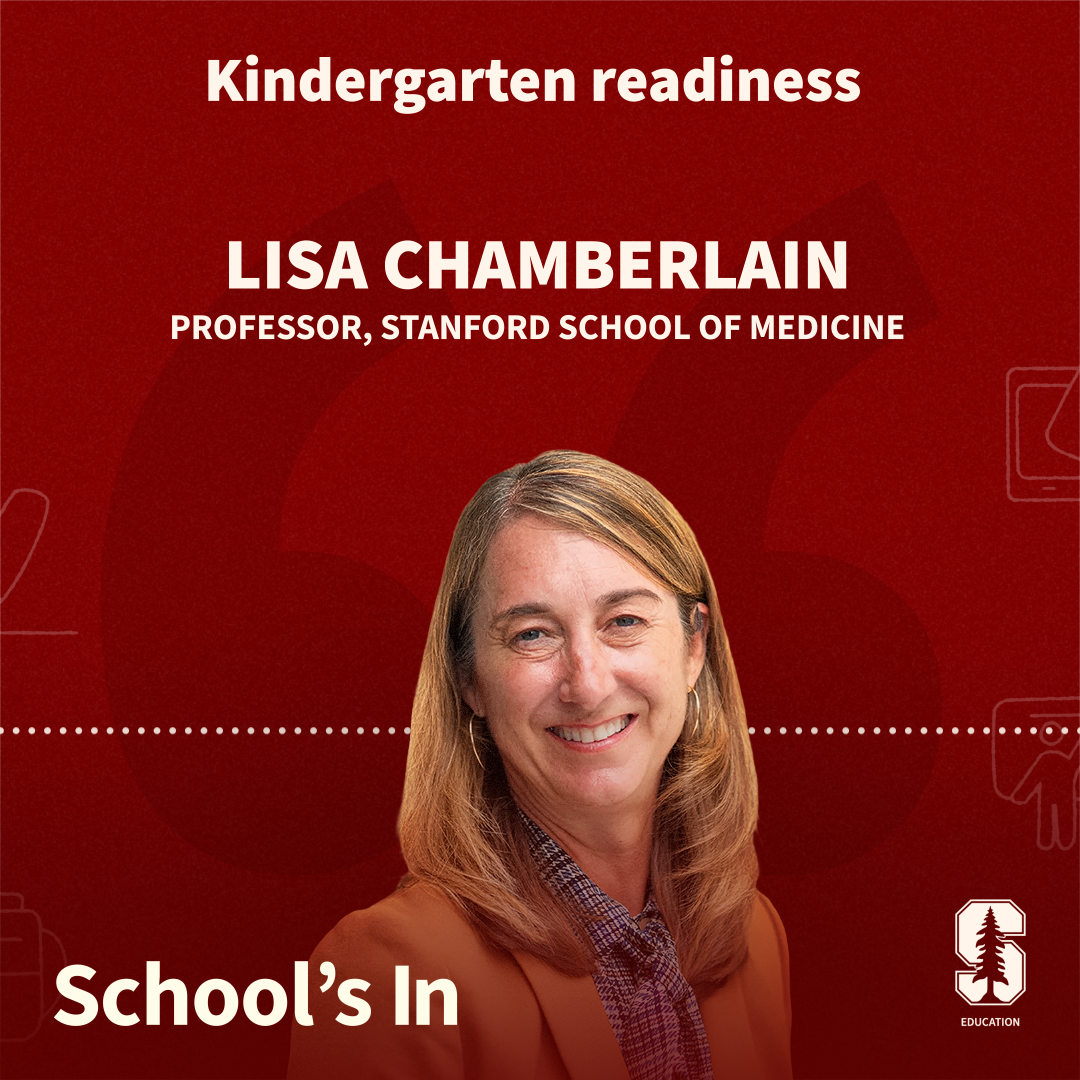
According to Stanford professor and pediatrician Dr. Lisa Chamberlain, the answer is yes. In screenings in her own pediatric practice, she noticed that many of her entering-kindergarten patients could not identify colors, write their name, or tell her the first letter of their names.
“I was like, ‘What’s going on here?’” she told School’s In co-hosts Senior Lecturer Denise Pope and Dean Dan Schwartz of the Stanford Graduate School of Education. “As I started to talk to the families . . . they said, ‘Well, that’s what they’ll learn when they get to school.’”
In a society where some families cannot afford to send their children to preschool, health care workers can help identify children who are at risk of falling behind.
“We are the people who see all these kids,” she says. “If you want to reach these families, you’re going to have to work through the health sector.”
Chamberlain’s research has focused on four types of interventions to promote kindergarten readiness: making the physical spaces of physicians’ offices more inviting and child friendly; providing learning materials, including free books; sharing tips for at-home learning via text message; and modeling best practices for literacy.
Chamberlain says medical professionals she speaks with are enthusiastic about these initiatives.
“This is something that gives them energy,” she says of her colleagues and peers. “We know that this is a problem, and it feels good to invest in some prevention.”
Chamberlain also believes more data could be shared between schools and medical practices to help identify children who need more support and to eliminate some of the redundancies parents face as they navigate both systems.
“The north star on this is how can we remove friction for the families… making it family centered,” she says. “Our systems work for us; they don’t necessarily work for families, and we’ve got to turn that around.”
Lisa Chamberlain (00:00):
The north star on this is how can we remove friction for the families and enhance what the providers have to work with.
Denise Pope (00:11):
Welcome to School's In, your go-to podcast for cutting-edge insights in learning. From early education to lifelong development, we dive into trends, innovations, and challenges facing learners of all ages. I'm Denise Pope, senior lecturer at Stanford's Graduate School of Education and co-founder of Challenge Success.
Dan Schwartz (00:34):
And I'm Dan Schwartz. I'm the dean of the Graduate School of Education and the faculty director of the Stanford Accelerator for Learning.
Denise Pope (00:44):
Together, we bring you expert perspectives and conversations to help you stay curious, inspired, and informed. Hi, Dan.
Dan Schwartz (00:54):
Hello, Mama Pope.
Denise Pope (00:56):
Oh (laughs), I'm a mama.
Dan Schwartz (00:58):
Yeah, we're talking about little kids, so.
Denise Pope (01:00):
We are gonna talk about little kids.
Dan Schwartz (01:02):
You have a bunch, or you had a bunch.
Denise Pope (01:04):
I have a bunch of kids. They're not little anymore.
Dan Schwartz (01:07):
No, it's sad.
Denise Pope (01:07):
I know. They're all old. But that's okay. No, it's... Uh, I'm very excited about this show. Um, we're gonna talk about the role of the pediatrician, and I have a question for you, Dan.
Dan Schwartz (01:18):
Yes, ma'am.
Denise Pope (01:19):
Did your pediatrician provide any advice to you when you were thinking about having your little guy start school?
Dan Schwartz (01:29):
Oh, interesting. No, he's just sort of scolded me. It was kind of his style to scold me as a parent. But, uh, the thing he did is he discovered that my kid needed glasses.
Denise Pope (01:40):
That's huge.
Dan Schwartz (01:41):
And so it was very cute. Like a li- a little two-year-old with, like, uh, teardrop lenses. Everybody thought it was adorable.
Denise Pope (01:47):
Oh, so cute.
Dan Schwartz (01:49):
But other than that, not much. How about you?
Denise Pope (01:51):
No. I mean, I can... Glasses, first of all, let's not undermine that. That is huge, right?
Dan Schwartz (01:56):
Yes.
Denise Pope (01:56):
If you figure that out before a kid goes to school, 'cause a lot of times I think they don't figure it out till, you know, second, third grade when it could be really late. So that, that's absolutely huge. No, I had a great pediatrician. I love my pediatrician. She didn't scold me (laughs), but it didn't really come up when my kids were little. It was just sort of like, "Oh, they're starting school. Great." You know?
Dan Schwartz (02:14):
Yeah, yeah.
Denise Pope (02:14):
It was just not a, not a thing.
Dan Schwartz (02:16):
It never really occurred to me that the pediatrician would have something to say about my child's life in school. You know, these, these are two great institutions, first five years of the doctors. From then on, it's the schools.
Denise Pope (02:28):
Oh, interesting.
Dan Schwartz (02:29):
So it, it never occurred to me that they would have something to say to each other. It was just a clean handoff.
Denise Pope (02:34):
Well, that's why I'm really excited about this show because our guest really has a different take on this. And I'm excited to bring her in. So our guest today is Dr. Lisa Chamberlain. And Lisa is a professor of pediatrics at Stanford School of Medicine and director of the Office for Child Health Equity, and she's also a faculty affiliate with the Stanford Center on Early Childhood. So welcome, Lisa. We are so excited to have you here.
Lisa Chamberlain (02:59):
Oh, well, thank you so much for the invitation to come and talk with you both. Very excited.
Dan Schwartz (03:04):
So Lisa, what are some examples of where, uh, the doctor's office and the schools would interdigit, so to speak?
Lisa Chamberlain (03:12):
Yeah. I wish there were more. There are a couple where we tend to interact. Some are around our learners, uh, our patients who have, uh, difficulty with learning. So we will often get information from the school saying that this young person is having a hard time paying attention or could you please help us think through if this child needs some medication. That's how the schools tend to reach out to us.
(03:36):
Sometimes we will reach out to the schools then in response and say, "Yeah, give us some more data. What are you seeing?" And that's an important part of helping to diagnose ADHD. So that's one of the areas where we really interact is in co-managing and, and helping to partner so that that child is ready to sit and focus and, and be successful. But other than that, we don't interact as much as we really could and should, I think.
Denise Pope (04:01):
And I just wanna be clear, Lisa, what age group are we talking about when you just gave that example?
Lisa Chamberlain (04:06):
Yeah. Where I see schools interacting right now with the doctor's office, it's more in the K through 12 space and tends to be around health-related issues in the schools. In terms of where I think we could be going more is in the zero to five space. The early childhood system here in the United States is quite fragmented and, uh, the pediatric office, the health sector, uh, 'cause sometimes it's family practice doctors.
(04:28):
It's not all in the purview of pediatricians, but the health sector tends to, uh, see all the kids. Um, all the kids are more or less born in the hospital and, uh, 100% of them go off to kindergarten. But in between that zero to five, there's a lot of different places, whether it's formal childcare, informal childcare, uh, there's just no real comprehensive system here. But the one thing that is consistent across all those years from zero to five are the series of checkups that the kids have to make sure things are on course.
(04:59):
And we see them very routinely for vaccines, developmental checks, checking vision, Dan, as you alluded to, checking their hearing, making sure they don't have anemia. So we're screening for a lot of things so that we can pick up and identify and, and help support kids so that they're able to develop to their fullest.
Dan Schwartz (05:17):
So what are some of the possibilities? Like, uh, the doctor would diagnose reading difficulties or, uh, numeracy? What are some of the examples?
Lisa Chamberlain (05:26):
Yeah, we absolutely could be doing screening for kindergarten readiness. We could be helping families, uh, if it looks like their child is not on track to be ready for kindergarten, helping them with a kinder-ready coach. So this is something we could do at three or four, right? Those really powerful neurodevelopmental years when the kids' brains are developing so fast at such a rapid pace, it's really an opportunity to be able to quickly get in there and help kids get on track.
(05:54):
And I wanna make a quick distinction. Uh, we do do that for kids who have developmental delay. So we are screening all kids very routine cadence for any kind of signs of delay. So difficulty not speaking on time, difficulty with fine motor skills, difficulty across a bunch of different developmental domains. When we pick that up, that's about 15% of children will have some sort of developmental delay.
(06:18):
And those go into our early intervention services, EI services, our regional centers. Those kids, we definitely in pediatrics have a path for. That is our job. It's a gold standard of care that we pick up and diagnose those kids and get them the help they need. The other 85%, the kids who pass the developmental screener, some of those kids are not ready for kindergarten, and it tends to fall along socioeconomic lines.
Denise Pope (06:42):
What does not ready for kindergarten mean to a pediatrician?
Lisa Chamberlain (06:46):
Yeah. So this is actually something that I encountered. I was a pediatrician in the community and I was watching as these, like, kids were growing up and turning four and five and I'd been taking care of them since they were born. And as I got them at four and five and was doing that pre-kindergarten checkup, which is my favorite checkup, they're so cute at that age, I would, uh, be doing some screening and say, you know, for example, "What color's my sweater? What color's the paper on the table? What does your name start with? Show me how you write your name."
(07:16):
Give them a little crayon and ask them to write it on the, the paper on the exam table. And so many of my kids could not do that at five. And I was like, "Wow, what's, what's going on here?" 'Cause I know developmentally, kids... Now, again, these are kids that screen normal. They do not have developmental delay, but they weren't ready for kindergarten. And as I started to talk to the families, I asked, you know, "What's been going on?" And, and they just, they said, "Well, that's what they'll learn when they get to school."
Denise Pope (07:44):
Hmm. Yeah.
Dan Schwartz (07:45):
That was my thought as well.
Lisa Chamberlain (07:46):
Absolutely. So this is a clinic that serves families on public insurance, Medicaid, families that are recent immigrants. It's, uh, the socioeconomic group that needs a lot of resources and support, there were... are not enough Head Start spots. So even if families wanted to get their kids in preschool, it's... private preschool's prohibitively expensive, and Head Start, we don't have en- enough spots. And so these are kids that are, are going into the system that really are not ready to start.
(08:11):
And so that was my sense. I was really seeing that a lot. And so one of the very first studies we did was we asked the children to do a kinder entry assessment, one of the tests that we use, standard test in California, and only 15%, one five percent, of the kids in our clinic were ready. So typically, in Palo Alto, or say a, uh, upper income area, 85% are ready. Again, 'cause 15% are gonna have that developmental delay.
(08:38):
So what we started to do at that point was really start talking about, "Well, you know, is this our job? Is this the pediatric job? Is that something that we should be doing?" Because again, we are the people who see all these kids. If you want to reach these families, you're gonna have to work through the health sector until we have a universal preschool situation, which we just don't have.
(09:00):
And so even if we do have universal preschool, we're still looking at zero to three, where there are a lot of things we could be doing. So yeah, it started me down this path to think about how could we transform the pediatric clinic to be a clinic that prepares all children to be ready to start kindergarten so that they can start off on that equal footing with everyone else.
Dan Schwartz (09:20):
So, uh, it'd be helpful for me to make it a little more concrete. So I'm bringing my three-year-old in to the doctor's office, you're busy, you have these people you're getting through. Is there a nurse giving them reading tests? Uh, and then after you do your diagnosis, do you s- say to the parents, "Okay, you must take four callers per day"?
Lisa Chamberlain (09:45):
(laughs)
Dan Schwartz (09:45):
Like, like, how does this play out?
Lisa Chamberlain (09:47):
These are great questions, and Dan, we don't have evidence-based interventions at this point. So you're articulating one vision. Like, we could have part of the pediatric team assess all the kids, where are they in terms of being ready to start kindergarten, and then what would the, uh, evidence-based interventions be for that?
(10:07):
So for instance, would it be going to the library more, getting more library cards and more reading? Is it more fine motor things? They need puzzles, they need manipulatives. Is it that they need more practice with speech? Like, that is one solution. I do think regardless of whether it's texting or coaching or other kinds of things, number one, it needs to be really evidence-based, but also we really have to think about whose job is it in the pediatric office to do that. And I don't think it's the physician's job. We weren't trained in this.
(10:35):
I, I don't see that changing. I know that we understand the power of education as a social determinant of health, and we understand that this is really important, but I think it's gonna require a team-based approach to operationalize it. And we're moving to a team-based approach about, around a lot of different topics, not just this one, so that wouldn't be radical.
Dan Schwartz (10:54):
Right, but be- before you, before you get evidence, you still need to have some creative ideas that are worth testing.
Lisa Chamberlain (11:00):
Mm-hmm. Mm-hmm.
Dan Schwartz (11:00):
So, so what are you doing in your office?
Lisa Chamberlain (11:02):
So we've got a, a suite of, of things that we do. They fall in four areas. One is, uh, changing the physical environment. So when... picture your kid's pediatrician's office, what did it look like, Denise? What was on the walls?
Denise Pope (11:16):
They had all sorts of, like, animals, zoo animal type things on the wall. They had a fish tank. They had Highlights magazines on the tables and some coloring books and crayons on the tables while we were waiting. And this is gonna sound crazy, but I didn't like to go into the waiting room because there... I figured there were a lot of sick kids.
(11:37):
So I would wait till the very end (laughs) to take my kids in there, and I'm thinking, "Uh-oh, well, should I have taken them in earlier so they could get advantage of all of Lisa's resources?" But that's what our waiting room looked like.
Lisa Chamberlain (11:47):
Was yours s- similar, Dan?
Dan Schwartz (11:49):
Uh, I think mine had, like, cross-sections of the knee, you know-
Denise Pope (11:53):
No, what-
Dan Schwartz (11:56):
... closeups of the ear.
Denise Pope (11:56):
No, come on.
Dan Schwartz (11:56):
(laughs)
Denise Pope (11:56):
That's your doctor's waiting room. (laughs)
Dan Schwartz (11:58):
Yes. That is my doctor's waiting room. (laughing)
Lisa Chamberlain (12:01):
Yeah. So, uh, uh, most of the clinics, uh, all of the clinics, like at Ravenswood where I worked, and all of the clinics here in San Mateo County, when you walk in, when you used to walk in, I should say, where they were blank walls, they were beige and they were plastic chairs, uh, locked together.
Denise Pope (12:17):
Wow.
Lisa Chamberlain (12:19):
So picture that.
Denise Pope (12:20):
Very different.
Lisa Chamberlain (12:21):
Almost like a, a old airport [inaudible 00:12:23].
Denise Pope (12:22):
Yeah.
Lisa Chamberlain (12:23):
Like picture that, right? Like-
Dan Schwartz (12:24):
Yeah, that's pretty grim.
Denise Pope (12:24):
Clinical.
Lisa Chamberlain (12:25):
Yeah.
Denise Pope (12:25):
Yeah.
Lisa Chamberlain (12:26):
It says a lot. It says a lot to the families. And so one of the things we've done is to help change that space and had murals put up in a lot of those spaces, little tables like you're talking about, uh, all of those kinds of things. So changing the space. The walls speak. What are we saying to these families, you know?
Denise Pope (12:43):
Huge. Huge.
Lisa Chamberlain (12:43):
Interaction is important.
Denise Pope (12:45):
Yeah.
Lisa Chamberlain (12:45):
And one of the, one of the interesting things, one of the places where we did at May- the, the Mayview Clinic, I was... just went through and was like, "How's it going with the new mural and everything with the office staff there?" And they said, "You know what's interesting? We noticed the parents aren't on their phones as much."
Denise Pope (12:57):
Oh.
Dan Schwartz (12:59):
Oh, that's nice.
Lisa Chamberlain (13:00):
They're looking around, they're interacting.
Denise Pope (13:01):
Wow.
Lisa Chamberlain (13:01):
Yeah. So changing the space. The second thing is materials of learning. So we need to get more books into kids' homes, more materials for learning. And so one of the things we've set up is something called Little Libraries.
Denise Pope (13:12):
Mm-hmm.
Lisa Chamberlain (13:13):
So all of the clinics in San Mateo have bookshelves in them now in their waiting rooms and they are full of books that families can take. So these are gently used children's books, everything from zero age to, uh, teenagers and families can take as many as they want.
Denise Pope (13:27):
Wow.
Lisa Chamberlain (13:28):
There was this whole thing, "Oh, they should only take one. Who's gonna monitor it?" I'm like, "Are we really concerned people are gonna take too many books? Like, I, I'm not worried about that."
Dan Schwartz (13:34):
(laughing)
Lisa Chamberlain (13:35):
"They can take as many as they like." And, uh, so we have, uh, at this point put more than 18,000 books into the community.
Denise Pope (13:42):
Wow. Lisa, that is so amazing. That's huge. That's huge.
Lisa Chamberlain (13:47):
Yeah, it's exciting. It's fun.
Denise Pope (13:48):
Yeah.
Lisa Chamberlain (13:48):
And, and people have all their old little used books. Like, kids don't go through those books, right? You don't wanna throw those away. What are you gonna do with them? Uh, the third thing are other ways to reach out between the clinic visits. So this is Dr. Loeb's intervention with texting. So she has a, uh, Tips-by-Text program, which has beautiful evidence, and I've replicated it now in our doctor's offices where the families get three texts a day, and it helps them to guide how they talk about issues of learning.
(14:15):
For instance, you would get a text, Denise, that says, "On Monday, your child is four, they're learning about numbers, and so think about that." And then on Wednesday, it would say, "Tonight, Denise, count the items on your kid's plate." So a really concrete thing that builds on Monday, that's something you can just integrate into your life. You don't have to stop and do anything different. And on Friday, it's like, "Good job, you're teaching your child to think about numbers," or something like this.
(14:39):
So being able to deploy those texts, those suite of texts from the clinic is something that we are building into the clinics. And then the last thing is storytelling, thinking about how can we help families understand how to use books. And so we have Stanford undergraduates who go into the waiting rooms in all of our clinics in San Mateo. It's got this beautiful mural and it's got its bookshelf, and the Stanford undergrad is sitting on the floor and the kids are kinda walking around and like, uh, say a three-year-old and say, "Okay, go get a book."
(15:10):
And so the kid gets a book, and they'll sit, and they'll do book sharing. So some parents don't know that you don't have to read the book. You can say, "What do you see on this page? Let's count the apples on that tree. What are the colors you see here," right? So dialogic reading, other ways to do book sharing. And so the Stanford undergrads are sharing books with the kids, uh, and, and role modeling and helping the, the families see other ways that they can interact with their children around literature.
Denise Pope (15:36):
Wow. (laughs)
Lisa Chamberlain (15:38):
So Dan, those are the four things we're working on.
Dan Schwartz (15:40):
No, it's really sweet. And, and independent of any diagnosis, those are great things to do.
Lisa Chamberlain (15:45):
Exactly, Dan.
Denise Pope (15:45):
Yeah, right.
Dan Schwartz (15:46):
Those are great things to do.
Lisa Chamberlain (15:46):
'Cause these are normally-developing kids.
Dan Schwartz (15:48):
Yeah.
Lisa Chamberlain (15:48):
They just need to be, uh, brought into this rich world of, of, uh, opportunities.
Dan Schwartz (15:55):
Yeah, of learning materials.
Denise Pope (16:01):
So Lisa, I think the suggestions you gave are absolutely amazing. I'm so excited about it, actually, for the kids. I can imagine, given the state of medicine today and how busy doctors are and how overwhelmed they are and how we're just trying to fight, you know, get people in the office and come in and get their vaccines, please, right? That they would look at you and say, "You're crazy if you think that we can take this on too." I mean, are you getting pushback? What, what's, what's the scene here?
Lisa Chamberlain (16:30):
Fair enough. The house of medicine is, uh, struggling. Uh, we had COVID, we, we're facing a lot of, um, pushback on science, so there are a lot of things going on. You're absolutely right. I have found that as I have been working with a lot of my colleagues, this is something that gives them energy. It feels good (laughs). We know that this is a problem and it feels good to invest in, in some prevention.
(16:56):
And so I c- I can say that I have seen a lot of acceptance around this and I think it's critical that in every office you're going to have, uh, much happier staff when everyone is working at the... we call it the top of their license.
Denise Pope (17:08):
Hmm.
Lisa Chamberlain (17:09):
So everyone is doing the work that they have been trained to do and you are, you know, really, most of your time is being spent there. We have nurse practitioners, we have medical assistants, we have nursing, we have community health workers. So we have a wide range of people who have been trained with different skillsets.
(17:25):
And I think that having, uh, someone who is focused on maximizing development, uh, which fits into school readiness would be a member of the team that I would lean on, but I wouldn't necessarily do their job. So as the medical leader of a clinic, uh, along with the clinic manager, you know, my role would be to think about it. Is this a priority? Is this a priority for our population of kids we're taking care of? Is this something we should bring in? Does the staff wanna do it? What does this look like?
(17:51):
If we could say, let's graduate 85% of our kindergartners ready for kindergarten, are people excited about that? If so, these are things we could do, but we would have to do it as a team. But the sustainability on this is the challenge. Where do you get the resources, um, to protect people's time for the materials, et cetera? And, you know, that kinda speaks to something where it's, uh, the wrong pocket problem where the costs in medicine, uh, the savings are captured in education, so you can't take the savings and, and pay for the intervention.
(18:19):
Um, and so there are different ways people are looking at this, social impact bonds, universal child budgets, different kinds of approaches, but those are structural things that are, are gonna require a bigger conversation. That being said, community health workers in California are a new benefit in Medicaid. So you can bill for community health workers, and that's the approach we're taking is to think about how community health workers can have an important role in our clinics around some of these things and we can bill for their time.
Dan Schwartz (18:47):
That's really interesting. Do you think if you could get the evidence, more money would get released for this? And you'd still have to figure out who gets to spend it.
Lisa Chamberlain (18:55):
Yeah. I think everything in, in medicine has to be based on evidence. So I think building the evidence is, is a key piece of this. I also think that being able to share our data is important. I think that right now, the data in the health system lives in the health system and the data in the education system lives (laughs) in the education system. And if we were able to overcome, uh, some technical issues, I think that that would really unleash a lot of opportunity, uh, for those two sectors to work together.
Dan Schwartz (19:24):
So that's interesting. Again, you need to make it a little more concrete for me. So I'm, I'm teaching algebra. I've got my kids in eighth grade. Why am I gonna go wanna see this shared database?
Denise Pope (19:35):
Or, or even younger kids if you wanna talk younger.
Dan Schwartz (19:37):
Okay. I'm teaching algebra to a four-year-old.
Denise Pope (19:38):
(laughing)
Lisa Chamberlain (19:38):
To a very gifted child. They're all gifted, slightly above average, right?
Denise Pope (19:44):
(laughs)
Lisa Chamberlain (19:44):
Um, so one example would be, uh, we do have data, uh, that we are able to share pretty well because people have really prioritized this. And the example of that is your vaccine record.
Denise Pope (19:54):
Mm-hmm.
Lisa Chamberlain (19:54):
So kids come in and they get their vaccines at these regular intervals, and that goes into the California Immunization Registry, and that registry is able to be seen by different providers. So preschool people can log in and see that, the schools can log in and see that. So that is this registry, CAIR, is visible. There's line of sight from different sectors.
Dan Schwartz (20:16):
Wait, wait. Lisa, does this mean... I have this little card.
Denise Pope (20:18):
(laughs)
Dan Schwartz (20:20):
This little piece of cardboard that I've been carrying.
Denise Pope (20:21):
Is it yellow? Is it yellow? The yellow card?
Dan Schwartz (20:23):
Yeah, yeah. I can get rid of it?
Lisa Chamberlain (20:25):
You would never wanna get rid of that yellow card.
Dan Schwartz (20:27):
(laughs)
Denise Pope (20:27):
Oh, my God.
Lisa Chamberlain (20:28):
I also raised my children in the yellow card age. That is becoming a thing of the past.
Denise Pope (20:33):
Oh, hallelujah.
Lisa Chamberlain (20:34):
Exactly, Denise, because, um, the ability to hold onto that card and move it through your life is difficult, right? There... You can see how that creates a lot of barriers for some families. And so this is all online now. You can print it out. And you know, it's so funny, it prints out and looks just like it.
Dan Schwartz (20:48):
(laughs)
Lisa Chamberlain (20:49):
And if you use yellow paper, it can look like a yellow card.
Denise Pope (20:51):
Oh, I love it.
Lisa Chamberlain (20:52):
But it still has the same format.
Denise Pope (20:54):
(laughs)
Lisa Chamberlain (20:54):
Um, but w- we love the idea of, you know, you bring your ki- your son in, Dan, and we checked the vision, Head Start has to check vision on all their kids. It's a huge lift for them. And it's so dumb because we're checking it in clinic and they're checking it over there, and it's like, "Wow, what if we all just could see that they passed the vision test in the pediatrics office? Oh, I don't have to test them in Head Start." Or, "You know what? You tested them at Head Start and passed. I don't have to check them here."
Denise Pope (21:18):
Yes.
Lisa Chamberlain (21:19):
So I think that there's some opportunities around things like that that make sense. And then you could take it further and say, "One thing I would love to see before I walk into a f- a four-year-old's room who's in preschool is how often do you go?" Uh, if I'm about to walk into a room and I see that they miss preschool 60% of the time, uh, that's gonna be a different conversation than if they're never absent.
Denise Pope (21:41):
Oh, you wanna see the attendance records?
Lisa Chamberlain (21:43):
I would love that.
Denise Pope (21:44):
Oh, 'cause they'll say, "Yeah, my kid's in preschool," but you as a doctor have no idea how much they've missed or if they're in two days a week or one day a week.
Lisa Chamberlain (21:53):
Yeah. Are there barriers there? Are there... So what other things could we be sharing that would strengthen each other's work? Obviously, there are privacy concerns, obviously, and on the healthcare side, we have HIPAA, on the educational side, you have FERPA. There are things, but these, these are things that I think just require courage.
(22:10):
I don't think that there are technical challenges we couldn't overcome. I think that we need to see the value of that and think of how we could do things, uh, putting the kid and the family in the middle more instead of asking them to do everything twice, right? But I think it would also enhance all of our work.
Denise Pope (22:25):
Amazing. And does not seem that hard, right? I used to have to go... If you forgot your card on the time that you-
Lisa Chamberlain (22:31):
(laughs)
Denise Pope (22:31):
And then you had to go back and I think you had to ask the pediatrician to sign something, so you had to wait and then bring it into the school. It was, it was kind of a nightmare. So I'm just happy that there is this (laughs) system of vaccine sharing, and if we could figure that out, we could probably certainly figure out attendance and whatnot, so.
Dan Schwartz (22:46):
I don't know.
Denise Pope (22:47):
You're a naysayer, Dan?
Dan Schwartz (22:48):
I d- I d... Lisa, this, this has to be a big lift to try and make a shared data-
Denise Pope (22:51):
(laughs)
Dan Schwartz (22:51):
... data infrastructure now.
Lisa Chamberlain (22:53):
Well, again, we've done it with CAIR, I mean, right? We've stood up this third thing in the middle-
Dan Schwartz (22:57):
Mm-hmm.
Lisa Chamberlain (22:58):
... um, where we, you know, import data from the health si- side and they can see it. You know, could they import data from the childcare side that would be worth sharing? So I hear you. One thing that California is doing is the, uh, Cradle to Career initiative, which maybe you've heard about, and where they're working on data integration is on the career side, the other end, and that is around being able to share transcripts.
(23:21):
So high school transcripts, if you've had kids go off to community college or college, you have to get the high school transcript and send it to... Right? So you're taking it from a California public school and you're handing it to, uh, UC or state, U... CSU, right? So that's, that's what they're working on now is, is working on that and the FAFSA form, the financial aid form, that all of that information just flows automatically.
(23:42):
Um, so there are examples of where California is working on this kind of data integration, again, thinking of the families in the middle of that, what would be easiest for them, uh, so that we remove the barriers for families where that's tricky. On the cradle side, they're thinking less, but we're involved in conversations with them around that and trying to think about how the Medicaid data and, uh, some of the state run preschools could think about some data integration. It's very early and it's fair, Dan, to be concerned. But I think that, again, I don't think it's a technical challenge. I think it's a mindset challenge, ultimately.
Denise Pope (24:16):
Fascinating, fascinating.
Dan Schwartz (24:17):
This may be too abstract, but this move that, that I feel like is being promoted is kinda making education and medicine reorganized around being family-centered. So like, kids go to school and the parents say it's the school's responsibility, right? Or the school says it's the doctor's responsibility. And so you pass through all these institutions and there's sort of no meeting ground in the middle.
(24:43):
So it's striking to me that, Lisa, that you're sort of talking about, "I'm looking at the social conditions of the families as a pediatrician to try and bring educational solutions." It's quite interesting that there's this sort of construct in the middle that's going to enable these different systems to be more effective and it's, it's around the family.
Denise Pope (25:03):
You kind of see that with community schools, right?
Dan Schwartz (25:05):
Yeah.
Denise Pope (25:06):
When the dentist office is there, maybe there's a health clinic there, and so this is just even making it further. This is, this is broadening that so you don't have to be at a special community to have these resources is what it sounds like to me.
Lisa Chamberlain (25:18):
Exactly. Yes. It's, it's how can we... The north star on this is how can we remove friction for the families? So look at all the friction points, making them fill out forms over and over again, right? And, and enhance what the providers have to work with. Absolutely. So thinking, making it family-centered, centered on what they need. Our systems work for us. They don't necessarily work for families and we gotta turn that around.
Dan Schwartz (25:42):
Boy, I'll tell you, my, my son's pediatrician was not in this frame of mind. (laughing)
Lisa Chamberlain (25:47):
I hope that that person has retired by now.
Denise Pope (25:49):
Probably. My-
Dan Schwartz (25:50):
(laughs)
Denise Pope (25:51):
D- guessing Dan's son age, probably that pediatrician is no longer working. But... So let's get into some advice. Lisa, if you were gonna talk to parents or providers, what's some sort of top things you would say based on this episode?
Lisa Chamberlain (26:04):
Absolutely. So for parents of young children, uh, I would definitely stress the importance of some of the things I alluded to, having lots of tools of learning in the house, so lots of books, lots of coloring opportunities, puzzles and things to do. So I think as much of that as possible. Libraries are an incredible resource in terms of books, in terms of other kids, in terms of exposure to all sorts of great things, right? So tapping into that.
(26:29):
I think for providers, there's, uh, so many programs. Reach Out and Read is the foundational program. Every pediatric office should have Reach Out and Read, if not some of the other things and building on the other things would be great. Again, depending on what your pediatric population needs, it may or may not be the things I've been talking about and that's okay. But what I would encourage everyone to think about is the importance of how policy influences these systems and universal preschool, uh, increased access to Head Start, these sorts of things.
(26:57):
I would encourage us as we think about our elected officials to think about who is prioritizing investing in early childhood. We know that there is a great return on investment for that, for the economically minded, for every dollar you invest in zero to five, you get $7 back ultimately in our system. And so I would just really encourage people to prioritize investing in early childhood and just, just thinking about that a little bit more.
Denise Pope (27:20):
Awesome. I've learned a lot in this show. I've learned not just what to do in terms of getting kids kindergarten ready, but also how the two different institutions can think about working together and that's so huge. And I love that you brought up politics and elected officials and funding and all that because we know how important that is today. So Lisa, this has been just a treasure trove.
Dan Schwartz (27:47):
I agree. Fabulously in- informative.
Lisa Chamberlain (27:47):
Appreciate that.
Dan Schwartz (27:47):
It was tremendous.
Denise Pope (27:48):
Oh, my gosh. Thank you, thank you. Thank you, Lisa, and thank all of you for joining this episode of School's In. Be sure to subscribe to the show on Spotify, Apple Podcasts, or wherever you tune in. I'm Denise Pope.
Dan Schwartz (28:00):
I am Dan Schwartz and it was-
Denise Pope (28:02):
Could you spell that, Dan?
Dan Schwartz (28:03):
Uh, I think it starts with the letter D. (laughing)
Denise Pope (28:04):
Hey, so does my name. Hey, we're both Ds. (laughing)
Faculty mentioned in this article: Christopher J. Lemons