Cultivating lifelong learners: The power of mindset
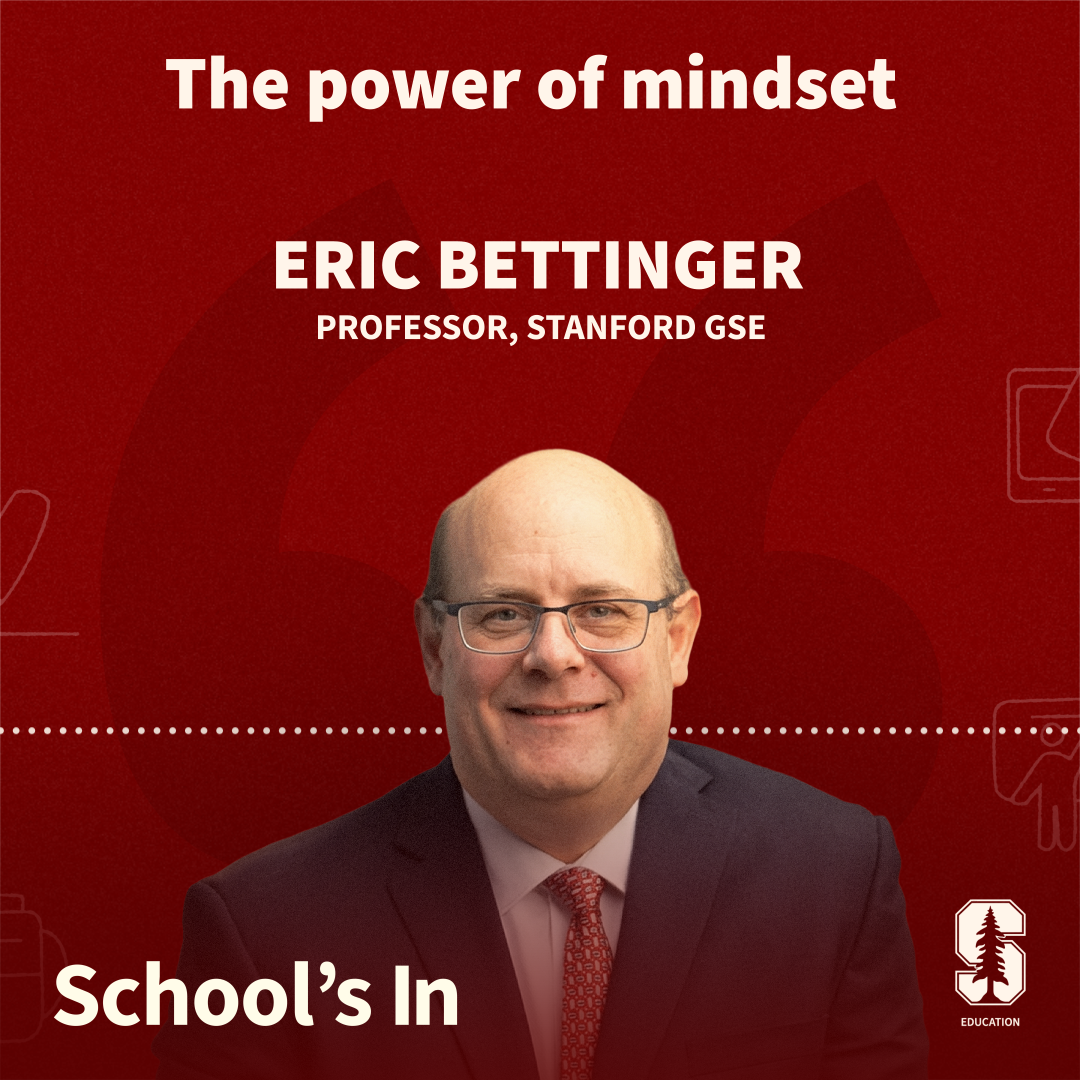
Parents and teachers who want children to embrace and welcome difficult challenges should encourage them to approach learning with a growth mindset, according to Eric Bettinger, the Conley DeAngelis Family Professor at the Stanford Graduate School of Education (GSE).
The term growth mindset, coined by Stanford Professor Carol Dweck to reframe perceived failures as opportunities to learn, has been around for decades; Bettinger set out to measure the long-term impacts of the framework. His research has shown that encouraging young people to think of their brain and intellectual capacities like a muscle—capable of expansion and improvement—can affect their drive to persist and decision-making even years later.
Students exposed to the growth mindset curriculum in one of Bettinger’s studies in Norway chose more challenging math classes, which made them eligible for more selective universities. These students continued to take advanced coursework three years after the intervention.
“That’s the most impressive piece,” Bettinger told School’s In co-hosts Senior Lecturer Denise Pope and Dean Dan Schwartz of the GSE. “We were basically able to influence the choice architecture that led to . . . a much more difficult, a much more academic route, a route that really prepared students in many ways for a more advanced training subsequently.”
That matters in a world that constantly changes, especially through new technologies such as artificial intelligence.
“What it takes to be a successful adult—it requires adaptability and learning,” Bettinger says.
Despite concerns about the use of artificial intelligence as what Pope called an “easy button,” Bettinger says the technology is compatible with a growth mindset: routine tasks with little cognitive load can be delegated to AI; for higher cognitive tasks, AI can be used to accelerate and expand learning.
A growth mindset is important in academic and professional settings, Bettinger says. But it isn’t enough on its own. People need to enjoy and take pride in accomplishing new things—and in the challenge of doing so.
“One of the things that we hope students have is . . . that kind of internal joy that they might have from accomplishing something,” he says. “And what we’d love is for intrinsic motivation and for other things to start to reinforce . . . their desire to continue to take on new challenges."
Eric Bettinger (00:01):
One of the, uh, parts of growth mindset, is that we have to get students to believe it's possible. But a second part of growth mindset, especially if we wanna see these permanent effects is, we have to find ways to support them in those decisions.
Denise Pope (00:18):
Welcome to School's In, your go-to podcast for cutting-edge insights and learning.
(00:24):
From early education to lifelong development, we dive into trends, innovations, and challenges facing learners of all ages.
(00:34):
I'm Denise Pope, senior lecturer at Stanford's Graduate School of Education and co-founder of Challenge Success.
Dan Schwartz (00:41):
And I'm Dan Schwartz. I'm the Dean of the Graduate School of Education and the faculty director of the Stanford Accelerator for Learning.
Denise Pope (00:51):
Together, we bring you expert perspectives and conversations to help you stay curious, inspired, and informed.
(01:00):
Hi Dan.
Dan Schwartz (01:02):
Hello, Forever Learn Pope.
Denise Pope (01:05):
(laughs), Forever Learn.
Dan Schwartz (01:06):
Well, yes. 'Cause today we're talking about, uh, making lifelong learners. And so this is something that, uh, people have aspired to for a very long time. You know, back in the day, students used to take Latin, 'cause people believed it made like a more muscular brain, so-
Denise Pope (01:24):
Oh.
Dan Schwartz (01:24):
You know, you take Latin, you're just more disciplined thinker. What do you think?
Denise Pope (01:28):
I don't know if I would wanna subject students to Latin again, but I am very all in on lifelong learning. In fact, you know, I love Dewey.
Dan Schwartz (01:37):
Yes, you do.
Denise Pope (01:38):
And John Dewey has this quote that I say almost all the time, which is, he says, "The most important attitude to be formed is the desire to go on learning." If we don't have people who wanna continue to learn, I'm not sure that society is gonna survive, because, uh, we're constantly having to learn new things. The world is not static, and so our learning should not be either.
Dan Schwartz (02:01):
So Dewey said a lot of things.
Denise Pope (02:02):
(Laughs).
Dan Schwartz (02:03):
Is there any empirical evidence that he's right about that?
Denise Pope (02:06):
Um, I, you know, this is maybe what our guest is gonna talk about today, is maybe there's some evidence there. I- I know that if you're not a learner, you're not going to be able to adapt to the changes in the workplace, in the world, right?
Dan Schwartz (02:21):
Well, f- fortunately we have like the nicest guy alive, uh, professor Eric Bettinger, who's, uh, an economist of education and he's gonna talk to us. He's also the Conley-DeAngelis Family professor in the Stanford Graduate School of Education, a senior fellow at the Hoover Institution, director of the Center of Educational Policy Analysis, director of the Lehman Center for Brazilian Education at Stanford, and a once-upon-a-time football player.
Denise Pope (02:46):
Eric, you must never sleep, oh my gosh.
Eric Bettinger (02:49):
Thank you for having me.
Denise Pope (02:51):
(Laughs), we're so lucky to have you here. So let's dive in, Eric. You have been looking at how to move folks towards becoming lifelong learners. Tell us why you think that's important, and also tell us a little bit about the studies, if you don't mind.
Eric Bettinger (03:05):
As you think about the need, especially in this kind of dynamic economy we're in, where we're learning new things, we have new things appearing, if we do not have the capacity to adapt and to start and to introduce and to engage in new technologies, it's gonna be very difficult for us to continue to have the kind of progress we've had in the past. So, you know, that's the big picture, right. You know, these two studies that we're gonna talk about today, really kind of focus on Norway and, uh, a little bit in the United States, trying to understand whether or not you can actually teach this kind of adaptability to students. And when's the right time to do it, and whether or not you can generate kind of long-run differences in the outcomes form as a result of it.
Denise Pope (03:47):
Love it. So how do you go about trying to study the teaching of adaptability in students?
Eric Bettinger (03:54):
Well, so, uh, you know, my expertise in education is really trying to think about how do we identify causal answers to questions. So I do a lot of randomized control trials, and in these particular studies we're talking about, we did some randomized control trials in Norway where we taught and introduced a curriculum to some students, that really focused on the development of what we call a growth mindset. And with other students, we allowed them to kind of continue as normal. We taught 'em something about the- the brain, but we didn't really frame it around growth mindset.
Dan Schwartz (04:25):
What is growth mindset? Like does it mean I'm gonna get taller?
Eric Bettinger (04:29):
(Laughs).
Dan Schwartz (04:29):
Or?
Denise Pope (04:29):
(Laughs).
Eric Bettinger (04:31):
So growth mindset, and Carol Dweck is the one who, (laughs), who kind of posited what growth mindset is. It's that, a be- belief that our abilities can be developed with effort, with strategies, with feedback. It's our willingness to take on challenges, to have those, uh, learning opportunities that we have.
Denise Pope (04:50):
And that's gotta be related to lifelong learning. If you don't believe that you can learn something and something new hits you, then you need to have this growth mindset. Is that- is that the- the thought pattern there, Eric?
Dan Schwartz (05:02):
I think part of it is, the alternative is a fixed mindset, that you really can't get better and that becomes an impediment to people trying to grow.
Eric Bettinger (05:11):
I think both of you are exactly right. It's both. If we don't have a growth mindset, the opposite is we're not learning, and we're not willing to learn. And as we start to think about what it takes to be a successful adult, uh, (laughs), it requires adaptability and learning.
Denise Pope (05:27):
Okay. So how, now how do you measure something like that? That seems hard to measure?
Eric Bettinger (05:31):
This is kind of an interesting one, because the social psychologists are really the group who have developed a growth mindset and the science around it. And they've done a wonderful job. And one of the things that happened was, economists were trying to replicate this and people were struggling to do so. And one of the things is, we've gone to the social psychologists and said, "Teach us how to do this." And it's amazing that some of the training that Carol Dweck and her colleagues, especially David Yeager have put together, really focused on both helping students to understand the metaphor that the brain is like a muscle that needs some exercise. And then secondly, to help them understand who are some of the people in our society who've demonstrated that type of growth mindset and what differences has it made for them.
Dan Schwartz (06:14):
So the idea is, we- we give the kids a metaphor for how the brain can grow, the neurons reach and touch each other. Which has gotta be helpful compared to like saying, "No, you can get smarter." Which is really abstract, and I- I have no idea how that could take place. So I say, "No, your brain, the neurons will stretch as you try harder." And then you get examples, uh, of people who, that you respect and have a growth mindset and they- they expose it, so they become as, a powerful model for you to further believe in the idea that you can do better. Is that, did I get it, Eric?
Eric Bettinger (06:50):
I think that's essentially it. I- I would also say that it's also just helping them understand a little bit about their identity and reshaping their identity around things that aren't fixed in their life. You know, like, um, as my kids were growing up, you know, I had one daughter who struggled a little bit in math, and it wasn't that she was bad at math, it was, uh, that she really had convinced herself that she wasn't a math person. And that was the line that she would give me all the time.
Dan Schwartz (07:17):
Denise, are you listening to this?
Denise Pope (07:19):
I am listening. This is, that was-
Dan Schwartz (07:21):
You are a math person-
Denise Pope (07:22):
That was sort of me-
Dan Schwartz (07:23):
You can become a math person, Denise (laughs).
Denise Pope (07:24):
It was sort of me growing up, Eric and I, yes, I had to adopt a growth mindset around math, which is often tested, uh, in this podcast.
Dan Schwartz (07:33):
(Laughs). So Eric, you're in Norway and- and you take half the kids and you put 'em into a class where they get like three hours of someone explaining they can grow, and then the other half are just in a standard classroom without the treatment. Is that how it went?
Eric Bettinger (07:47):
The way that when you do these types of things, we find that it's, uh, the more personalized experience they have and you know, for some of the statistical reasons, you wanna make the variation happen within the classroom. So we actually designed this curriculum where students would basically put on a headphone and they would sit in their classroom and they would watch a- a video, about an hour long video that would describe it. And two weeks later we'd come back and show another video.
(08:11):
But in that context of that video, you know, students were having a very personalized experience. Now, what happened in the classroom was, all of them saw the same graphics, but some of them were getting an explanation of the plasticity of the brain, and the others were actually getting the metaphor, that growth mindset, uh, and the muscle is, uh, something that needs exercise. And for me, uh, you know, when I was reading this, uh, the kind of social psychology lite- literature, most of the evidence in growth mindset is based on those kind of immediately after. Uh, I'm much more interested in what happens a month later, two months later, a year later, and so forth. And that's really the focus of the studies, is to try to see how can we actually change that condition later in the process and not just at that moment.
Dan Schwartz (08:53):
This is great, Eric. There are studies that- that have, look at long-term effects, but a lot of them maybe not as precise as what you did.
Eric Bettinger (09:01):
Well, so here's the unique place, uh, that we've learned and here's kind of the unique contribution that I think the study gives. We did growth mindset at, during e- essentially this time that the students have to make a decision within the Norwegian context, as to what they're going to do over the next couple of years. Are they going to attend an academic school that would prepare them for a university, or are they going to attend, uh, some type of vocational school? And what type of math courses are they going to take once they get there? Are they going to go on a route where they, uh, take the kind of lowest possible, uh, math offerings that are available. Um, in Norway that would be kind of a- a year of practical math and maybe a second year of practical math and no need to take math in the third year? Or do they try something that's much more difficult, where they're really thinking about the most a- advanced math that they possibly can.
(09:53):
And one of the things that was unique about our study, was because of the timing of when we did this, we got to see how this influenced their likelihood of actually taking a real risk, a real determination to follow over the next year or years, a different track.
Dan Schwartz (10:08):
Yeah, this is really clever. How far after the intervention was the decision point for the kids to decide where they wanted to go?
Eric Bettinger (10:17):
So we- we put it right in the middle of the decision, and I think one unfortunate part was a- at least a third of our sample had to make a decision before we actually did the intervention. But the other two thirds were making decisions in the process of it and had to make those decisions going forward. And what we saw is, even though we didn't affect which school they went to, we did affect what classes they took. And we saw that it wasn't just right after the moment, it was that they had committed that the next year they were gonna take a more challenging math class. And then we followed them for a good three years after it, and it's not just that they started on those track and then gave up, they kept on doing it. And so that's the most impressive piece, is three years after this, you know, two-hour intervention across three weeks, we were basically able to influence the choice architecture that led to, subsequently, a much more difficult, a much more academic route, a route that really prepared students, uh, in many ways for more advanced training subsequently.
Dan Schwartz (11:19):
No, that's- that's really exciting. Um, so there's a- a lot of different bets on what you should do to help, uh, students, you know, into the future. So, uh, number of people focus on belonging. You- you should put, you help them feel like they belong in the current situation, maybe the future situation. Uh, me, I'm more of a knowledge guy, like, uh, give 'em the knowledge that helps them actually be able to adapt. And so it's sort of useful to know how big is the effect.
Eric Bettinger (11:48):
The easiest way to think about this, when you look at the kind of the probability that you took this advanced course, you know, it really is modest in terms of what its meaning is. But one of the things that happens in the Norwegian context, is when you apply to college, you get points, a little bit like we do in the United States with AP, you get extra points if you've taken these more difficult math classes. So what we're talking about here is enough bonus points that it really enables you to go from a moderately selective college, to one of the more selective colleges in the country. And going from, uh, potentially choosing a major that, uh, um, is somewhat difficult to get in and making it to where it's really attainable to a student, particularly a student who hadn't actually had that kind of background or training in their family and in their schools to have that growth mindset.
Denise Pope (12:42):
Okay, wait. 'Cause it sounds amazing, right. It sounds like you have changed the trajectory of a kid's life with a two-hour intervention. I mean, uh, that- that's like, everybody would want that, right? I'm- I'm gonna be a little bit more skeptical, I think the two-hour intervention may lead them to do something in the immediate realm, but it's gotta be something about the taking of the challenging class that then motivates them to continue to take the challenging classes, right?
Eric Bettinger (13:11):
This is the hard part and I think this is the place where, you know, we- we start thinking about this kind of second component that haven't come up in our discussion. I mean, one of the, uh, parts of growth mindset, is that, really, we have to get students to believe it's possible. But a second part of growth mindset, especially if we wanna see these permanent effects, is, we have to find ways to support them in those decisions. And so as you start to think about both the supportive environments and so forth, how do we do that?
(13:37):
And so for, take for example, uh, the math instructors. As you start to think about the types of teachers who teach more advanced classes, the types of teachers who engage in those. If those teachers are instilling and reinforcing growth mindset, and if the peers that students have are reinforcing growth mindset, then you have these kind of reinforcing mechanisms that are driving students over time. So yes, a two-hour training starts the ball rolling, but as it starts rolling, you have a number of mechanisms around the students that can support them as they start to look for that kind of change.
Denise Pope (14:20):
Okay. So Eric, I have a question. If you think about teaching kids that the mind is a muscle, is that the answer that we teach kids, your mind is a muscle? Is that what you saw won out every time over the other conditions in the study? Help us understand that.
Eric Bettinger (14:36):
Sure. It's certainly in- in what we did, the mind as a muscle w- was the kind of metaphor that really resonated with students. But as you start to think about what does it take to really move it forward, it just can't be that flat message, i- it has to be something that becomes dynamic, that we start to scaffold. As an example, if you think about when we take on challenges, the, one of the things that we hope students have, is a satisfaction that comes, that kind of internal joy that they might have from accomplishing something. And what we'd love is for intrinsic motivation and for other things to start to reinforce that teaching that we have, that taking challenges really can help students on the other side to have those eureka moments, those moments of, wow I did it, those moments of accomplishment that can then, uh, reinforce their desire to continue to take on new challenges.
Denise Pope (15:28):
Mm-hmm. I just wanna point out, the Dewey nerd in me is that you are talking about educational experiences a la Dewey, right? It's that excitement that you get when you do something that makes you wanna try again in another way. It was a pleasant experience and you learn something and so you have the desire to go on learning.
Dan Schwartz (15:45):
Or we can get, have a, the control condition where I give them frequent flyer miles every time they try something hard.
Denise Pope (15:50):
(Laughs).
Dan Schwartz (15:51):
And I never tell 'em about a growth mindset.
Denise Pope (15:53):
The Maslow approach too, you know.
Dan Schwartz (15:54):
Yes.
Denise Pope (15:54):
Yeah.
Dan Schwartz (15:55):
Yeah.
Denise Pope (15:55):
Yeah.
Dan Schwartz (15:56):
Yeah, just, uh, reward 'em for trying hard.
Denise Pope (15:59):
Eric.
Eric Bettinger (16:00):
So going to this kind of comment, I mean, I think that one of the differences is- is in that literature that thinks about, maybe we can, you know, give them some type of extrinsic motivation to- to help them, as opposed to developing and strengthening intrinsic motivation. I mean, one of the biggest factors we find is that, you know, students, uh, feel sometimes when they're in a classroom, that it's a competitive zero-sum game. That if somebody else succeeds, that they fail. And part of what we want to try to think about, going back to that theme of a supportive environment, is, the great thing about growth mindset is everybody gains. Everybody can get it. And if you get it, it doesn't affect the likelihood that I get it. And so as a result, the intrinsic motivators of being on top, you know, fell, fall to the side. Because of that intrinsic motivation that I can do better than I did yesterday, and that I can be the best that I can be, really start to drive things, or at least that's our hope.
Denise Pope (16:55):
I love you so much, Eric. Dan and I talk about this on the show all the time, (laughs), so yay.
Dan Schwartz (17:01):
So this is how track athletes talk about it. You know, they, you ask them, did- did they, did you win? And that's no, the response is, "I did better than my last time."
Denise Pope (17:10):
Yes.
Dan Schwartz (17:10):
Right, that's what they're focusing on. It's, so it's- it's a very interesting. So Denise, I- I know you're dying to ask about AI.
Denise Pope (17:20):
(Laughs).
Dan Schwartz (17:21):
Right. It's all AI all the time, I know you want to ask, do it.
Denise Pope (17:25):
Okay. I see ramifications here, very important ramifications from your studies, Eric. When you look at AI, the problem I have with AI is it's an easy button, and if the kids are not motivated, if they think it's busy work, if they're overloaded, if, you know, if- if- if they're not into it, why not have this computer who can do the work for you, just do it? Why not push the easy button? And I'm wondering if there's some sense of, if you have a growth mindset, maybe you don't do this, or I don't know. Talk- talk to me about how we're gonna help people not push the easy button in schools.
Eric Bettinger (18:02):
A couple of things that I would suggest. One, just starting to think about a framework. You know, if you think about two descriptors of tasks that we have to do at school or in work or wherever it might be, one is, whether or not it's a routine activity and the other one, whether, what the kind of cognitive load that's needed when we engage in that activity. And if you think about AI and what AI is gonna do to our economy and some of the places, when it is a routine task that requires very little cognitive load, those are precisely the types of tasks that AI is going to replace. So I would put there that we can substitute AI for human effort.
(18:41):
But if we really want t- to capture the benefits and the potential of AI, then as you start to think about that other kind of, uh, part of it, the non-routine and highly cognitive tasks, in those cases, we need AI to be a complement. It can accelerate and expand learning beyond what we might have. So going to this question, you know, w- what are the types of tasks, what are the types of challenges that we give students? Do we give them routine, non-cognitive tasks, that eventually AI is gonna take over? Or do we push 'em a little harder to take things that aren't routine and things that aren't cognitive and really have them use AI to even accelerate and expand their decision-making powers? And for me, that's that second quadrant, where you start to think of AI as a tool to help you do better, that's precisely that growth mindset, where it comes in.
Dan Schwartz (19:33):
Yeah, I think Denise is thinking that the computer's gonna say to you, "You can grow, you can do it, try this."
Denise Pope (19:40):
I mean, right now it says, "You're the greatest thing ever," and, "Great question," and, well- "Y- you know, well done." It's just, it praises you all the time, I don't know that that's like, "You can do it."
Dan Schwartz (19:50):
Or it could give me points for whenever I- I try hard.
Denise Pope (19:53):
(Laughs). It could give you points, Dan.
Dan Schwartz (19:55):
Yeah.
Denise Pope (19:56):
You go, keep going back to extrinsic.
Dan Schwartz (19:58):
Denise, can I ask something that's on a different line here? This- this is about the-
Denise Pope (20:02):
I- I give you my permission.
Dan Schwartz (20:04):
Thank you. So I hear lifelong learner, or a nation of learners, Eric, I- I like that a lot. And the challenge is though, the workplace or out of school is very different than school. School has very defined structure, tests, things like that, teachers to help you. You know, in the workplace it's really different, right. And so the skills I learn in school may not actually transfer to make me a learner, or the attitudes in school may not work in this new context. So it's not guaranteed that the kid who's a good learner at school is a good learner on the job. So here's the question. What kind of measure could we put in the workplace to find out if people really have become, say, lifelong learners or adaptive learners? Like how- how would you measure this when they're on the job? And everybody's got different jobs, so it makes it tough.
Eric Bettinger (20:52):
I- I think this is a tremendously difficult question. But I think that part of where the research is going with this, is starting to measure the content of a job and to understand the proficiencies that an individual has to have. So instead of thinking about, you know, the job of a professor to try to think about it in its component parts, what are the specific parts we have? Uh, the teaching responsibilities, the counseling and mentoring students, (laughs). Whatever it might be, there are different tasks that are required of any given job. And as we start to think about those tasks, if we can understand and start to develop a metric of the likelihood that individuals become proficient, or improve their proficiency in those particular tasks, the better it is for us in terms of our ability to measure whether mindset's translating into something on the job force.
Dan Schwartz (21:41):
So I'd- I'd need to come up with, uh, sort of very specific measures for each workplace setting, to sort of see if there's growth over time in- in their skills and abilities.
Denise Pope (21:52):
Could it be each component skill?
Dan Schwartz (21:55):
Yeah, but they'd be domain specific. So like the- the skills of a dean are a different list of skills than the skills of a podcast host, right? And so you'd- you'd have to enumerate them, and then, the alternative is you just see, do people, uh, do well on assessments of growth mindset in 12th grade, get promoted faster in the job, you know, it'd be a proxy kinda measure.
Denise Pope (22:16):
I have another alternative.
Dan Schwartz (22:18):
Yeah.
Denise Pope (22:18):
You set up the problem that schools are not, like the skills that you need to do well in school are not necessarily the skills you need to do well in the workplace, change the schools.
Dan Schwartz (22:29):
Change the workplace, (laughs).
Denise Pope (22:31):
Change both at this point. My God.
Dan Schwartz (22:35):
Let's blow up the whole system, (laughs).
Denise Pope (22:35):
(Laughs).
Eric Bettinger (22:39):
The other direction that we could also take this, is also trying to think even outside of the schools. Uh, you know, one of the things we've talked about throughout this is, what are the supports around individuals and people interact more with their families and with some of their community, their religion or other things, oftentimes more so than they might, you know, this two-hour curriculum. And I think one of the things that, uh, I would love to see more research on, is trying to understand how do parents install and how do we help parents in their parenting to really help students from an early age, um, help children at an early age to develop that kind of opportunity and the eagerness and the ability to learn.
Dan Schwartz (23:18):
Oh, I like that. So if- if I give you a growth mindset at home, does it transfer into school. Closer to the question of, will it go to the workplace? I guess I could measure kids' growth mindset in school and see do they bring it home or do they bring it to, if they have a summer job, it'd be easier to measure that.
Denise Pope (23:37):
Or other interests and explain... The- the thing is, when you're interested, when you're naturally interested in something, you have that, right?
Dan Schwartz (23:44):
I think if you're interested in- in something, it's irrelevant. You- you're not thinking about do I grow or not, you're just interested in the thing, so you spend time on it.
Denise Pope (23:52):
Right. So hello, is that not the answer that we're talking about here? Get people interested in what they're doing at school, at home and at work. What do you think, Eric?
Eric Bettinger (23:59):
So we can go two directions on this. First, uh, let me tell you a story that, uh, really put in my mind that we need to understand what is growth mindset a little bit better than we do. I went to, um, my daughter was running for student body office at, uh, you know, sixth grade. And, uh, I went in to listen to the speeches and every speech ended, "And I have a growth mindset. You should elect me because I have a growth mindset."
Denise Pope (24:24):
(Laughs).
Eric Bettinger (24:24):
And you know, I actually talked to Carol Dweck a little bit about this, and there was a worry that any pro-social behavior was being interpreted as a growth mindset. And, you know, growth mindset is about that capacity and adaptability and that ab-, the desire to learn more and to take on challenges. But resilience, teamwork, you know, we could come up with a- a laundry list of other types of pro-social behaviors that can really improve productivity in the market.
(24:52):
You know, in our case, if we wanted to really see how it was transpiring, the first one is, uh, we wish we had data on the h- higher education records, what schools they went to, what majors they had? To see if they were taking on, uh, majors and actually taking on and attending schools that were more challenging than what we would've projected based on, you know, kind of the beginning of the intervention. And then if I were to take this into the labor force, trying to think a little bit more carefully about, as they take on those jobs, how are they learning and growing on that job in some meaningful way? I almost wish you could do a study of doctors and try to identify how doctors learn new tasks and learn new opportunities, learn new treatments, and whether or not somehow that's related to their capacity to adapt and to learn.
Dan Schwartz (25:40):
Uh, that's a nice- that's a nice target. They- they have, uh, a lot of incentives and structures to help them stay up to date. It'd be an interesting place to do it, to see.
Denise Pope (25:50):
Curious about some takeaways here, right. I'm a parent listening to this, I am a, uh, teacher listening to this. Eric, based on your studies, what are some of the pieces of advice you might offer to those two different folks?
Eric Bettinger (26:05):
I think for parents, believe that your child can learn and teach them as such. When my daughter shared with me many years ago that she was not a math person, trying to help her develop confidence and to develop the resilience and to help her develop a growth mindset to see that she had the capacity to learn. That was one of the most fulfilling things I had as a parent. As you thinking about teachers, trying to understand how to not only teach the principal in the way that we provide feedback, in the way that we support, but how to embed it in the way we talk to students, in the way we give assignments, in the way we give challenges to both encourage and strengthen their capacity to do so.
Denise Pope (26:50):
Dan?
Dan Schwartz (26:51):
Uh, I- I agree with Eric. It's one thing to help them believe they can grow. It's another for them to experience it. 'Cause I think just telling them will get grow thin, if they keep getting stuck. You want to give them opportunities to succeed at difficult things. You want to give tasks where the student can make progress and see where they've grown in things as opposed to a strong signal that you- you didn't get it right. So you- you let 'em know they can grow and then you put 'em in an environment where, you're gonna not like this, you reinforce their success rate. There's a reason to believe. Well, that's points, Denise. It's point, it's-
Denise Pope (27:28):
Well, no, there's other ways to reinforce success, right Dan?
Dan Schwartz (27:30):
Oh, there's, they- they've f- frequent flyer points.
Denise Pope (27:31):
(Laughs).
Dan Schwartz (27:32):
That's all that- that works.
Denise Pope (27:34):
No, but okay, I happen to agree with both of you, right. As I think about this, you do need a little impetus, a little push. Maybe that's the two-hour intervention, maybe that's the mind is a muscle, "Hey, uh, you are, there's no such thing as a not a math person," right. We can all learn. So that's the- that's the starting point. But then, to your point, Dan, you have to get them to experience the actual pleasure of growing. And if you make the task too easy or too hard or whatever, they're not gonna experience it. Or if they don't feel like they belong and they're not supported, they're not gonna experience it. So I think we hit on a lot of really important things. Eric, thank you so much for being here. And thank all of you, listeners, for joining this episode of School's In. Be sure to subscribe to the show on Apple Podcasts or wherever you tune in. I'm Denise Pope.
Dan Schwartz (28:23):
And I'm Dan, always growing, Schwartz.
Faculty mentioned in this article: Eric Bettinger