Dan Schwartz to step down as dean of Stanford Graduate School of Education
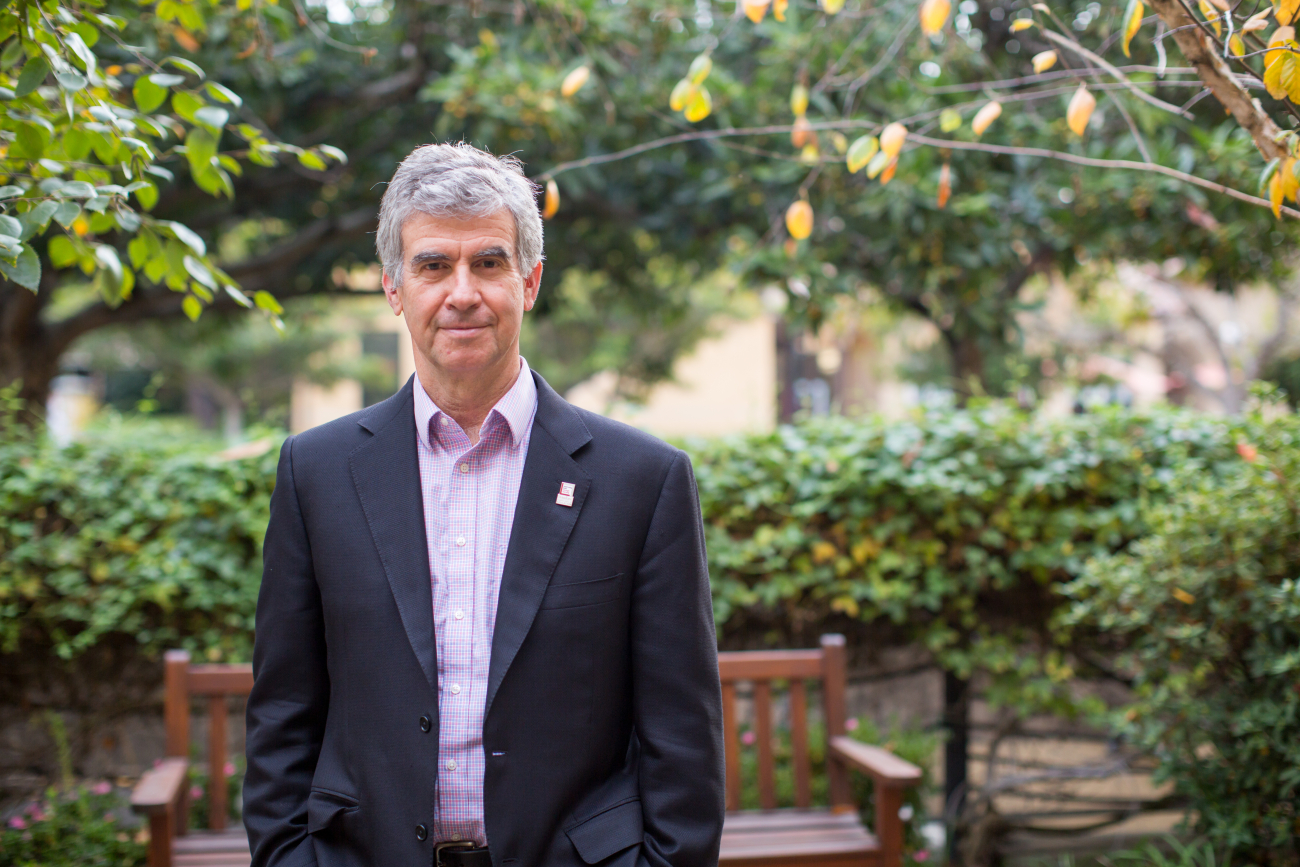
Dan Schwartz, who has led Stanford Graduate School of Education (GSE) through one of its most transformative decades, will step down as dean on Sept. 1, 2026, after 11 years of service.
Schwartz will return to teaching and research full time and continue to lead the Stanford Accelerator for Learning, a university-wide initiative based at the GSE to research and scale effective learning solutions. The provost has named a search committee to recommend a successor.
“I have had multiple privileges serving as dean,” said Schwartz, who began the role in August 2015. “One is the excuse to learn about the brilliant work of each faculty member. A second is helping to advance our fantastic, mission-driven staff.”
During his tenure as dean, Schwartz oversaw faculty growth in emerging research areas, a transformation of the school’s physical spaces, an expansion of academic programs, and a deepened commitment to translating research into real-world impact.
Schwartz’s leadership coincided with what he called "the dawn of data and technology in education"—a period that saw artificial intelligence emerge as a powerful force in learning and new sources of copious data expose gaps in and opportunities for learning. Additionally, his time overlapped with the COVID-19 pandemic that challenged educational practices and systems globally.
There emerged a recognition, Schwartz said, “that we needed to reimagine what a school of education could be for contemporary times.” His strategy focused on people, programs, and places to ensure the longevity of the school.
"Through more than a decade of significant upheaval in the field of education, Dan has brought visionary leadership and a strategic approach to guiding the GSE,” said Jonathan Levin, Stanford’s president. “As dean, Dan has consistently prioritized the toughest challenges in education, an approach that has helped raise the GSE’s profile as a leader in the field and deepened the school’s connections with our local and regional communities."
People: New faculty, new areas of study
Under Schwartz’s leadership, the GSE experienced a generational turnover in faculty, with approximately 60% of current professors having been hired in the past decade.
Rather than solely refilling the ranks with researchers focused on similar topics as those who retired, Schwartz pursued a strategy of cluster hires to build critical mass in emerging and essential fields. He also increased the number of professorships with joint appointments including in physics and pediatrics, and at the Doerr School of Sustainability, the Freeman Spogli Institute, and the Hoover Institution.
“Stanford’s primary mission is research and teaching - and that comes down to our faculty,” Schwartz said. “As a small school, we typically have one, maybe two, faculty members studying the same thing. We needed to be very intentional about building strength in areas where we thought we could make the biggest difference without losing our traditional areas of excellence.”
The GSE now has established a presence in early childhood education, learning differences, digital learning, equity in learning, and the brain and learning sciences.
Programs: Expanding opportunities
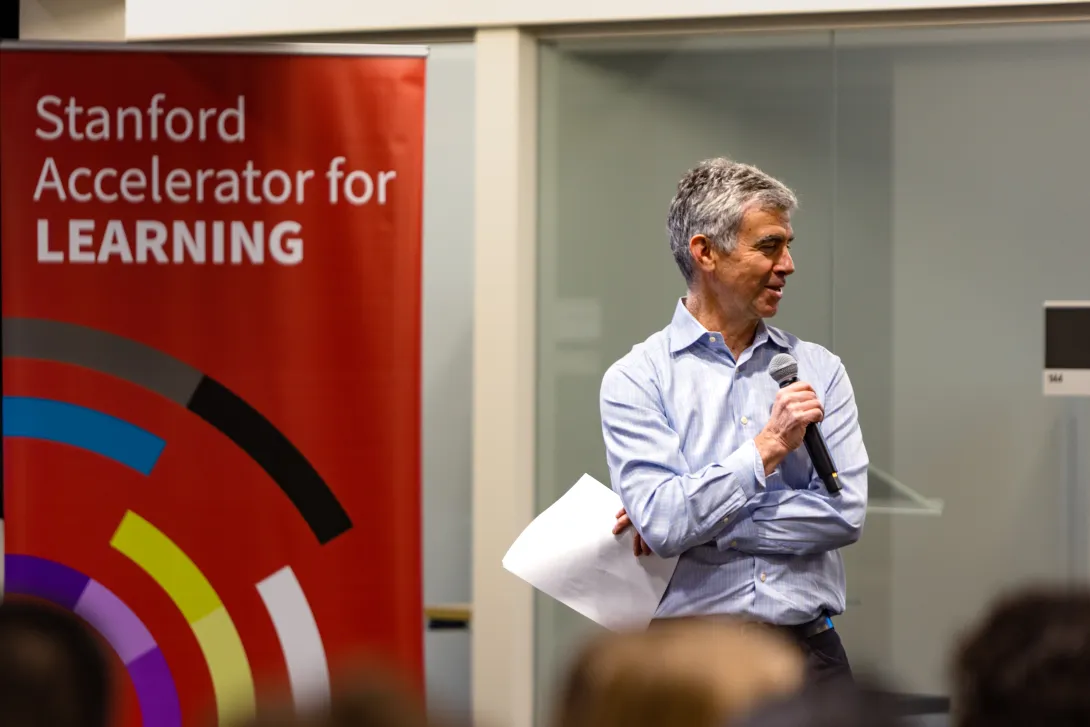
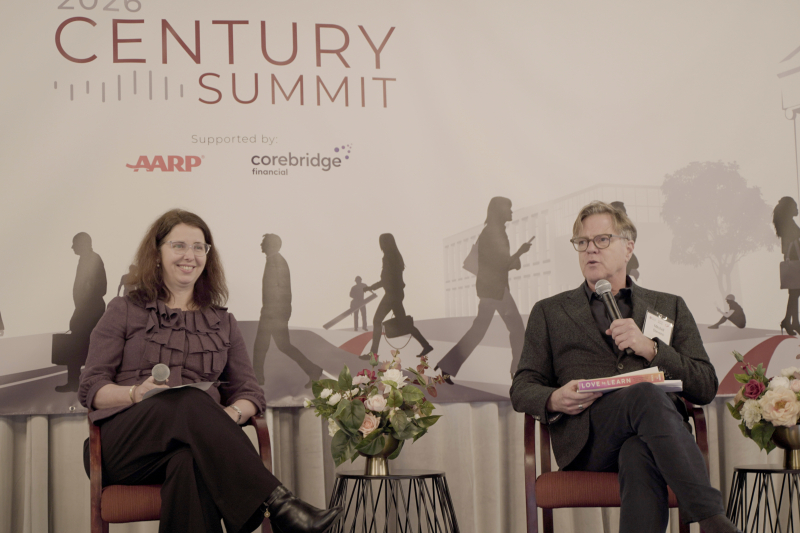
Dan Schwartz speaks at a Stanford Accelerator for Learning event. (Photo: Trevor Tachis)
This influx of new talent was matched by an evolution in academic programs.
Schwartz's tenure saw the launch of several new degree programs and initiatives. The school introduced the Race, Inequality and Language in Education (RILE) cross-disciplinary PhD program; a first-in-the-nation Education Data Science (EDS) master's program; and certificate programs in learning differences and research practice partnerships. The school also obtained university approval for a Master of Science degree that can now be applied across programs. Undergraduate offerings were also strengthened, from research opportunities in faculty labs to the minor and honors programs.
Significant effort also went into enhancing the student experience. Schwartz, with the Academic Affairs team, created the Student’s Collaborative Learning Fund to provide support to students pursuing intellectual projects that encourage camaraderie, creativity, and curiosity. They also increased student financial, advising, and mentoring support structures.
Over the last decade, Schwartz also increased engagement with alumni, whom he called the pride of the school. He presided over several ceremonies of the Alumni Excellence in Education Award spotlighting leaders from industry and nonprofits to teaching and research.
Real world impact
Central to Schwartz’s vision was creating pathways for research to be understood and used outside of Stanford.
Schwartz expanded the GSE research-practice partnerships with local school districts, adding the Stanford-Sequoia collaborative that encompasses nine districts in San Mateo County and has produced findings and action on topics including math tracking, English learners, and more.
He also created the Stanford Accelerator for Learning to bridge the gap between academic discovery and practical application. "Research is incredibly important, but there are not great pipelines for getting educational research into practice," Schwartz noted. The Accelerator was established to "get the whole university and their insights and discoveries out into the world faster with greater impact, whether it's through products or new kinds of knowledge or policy suggestions. The students have been fantastic agents of change."
The Accelerator has brought additional collaborations with education technology and nonprofit organizations, as well as a school partnership in Santa Clara County focused on improving opportunities for students with learning differences.
The launch of School’s In, the GSE podcast co-hosted by Schwartz and Senior Lecturer Denise Pope, was also part of the strategy to expand faculty reach and impact. "We wanted to figure out ways to get timely insights out there when they could make a difference," Schwartz said. He and Pope have recorded over 170 episodes, interviewing scores of researchers from across the university.
“Dan has been a transformative leader for the Graduate School of Education and for Stanford,” said Provost Jenny Martinez. “He has recruited the next generation of world-class faculty, invested deeply in student programs, and forged innovative partnerships that establish the GSE as not only a home for teaching and learning but also a hub for collaboration across campus and beyond. In addition, his counsel and advocacy have been invaluable as a member of Stanford’s leadership team.”
Place: A central home for community, collaboration and convening
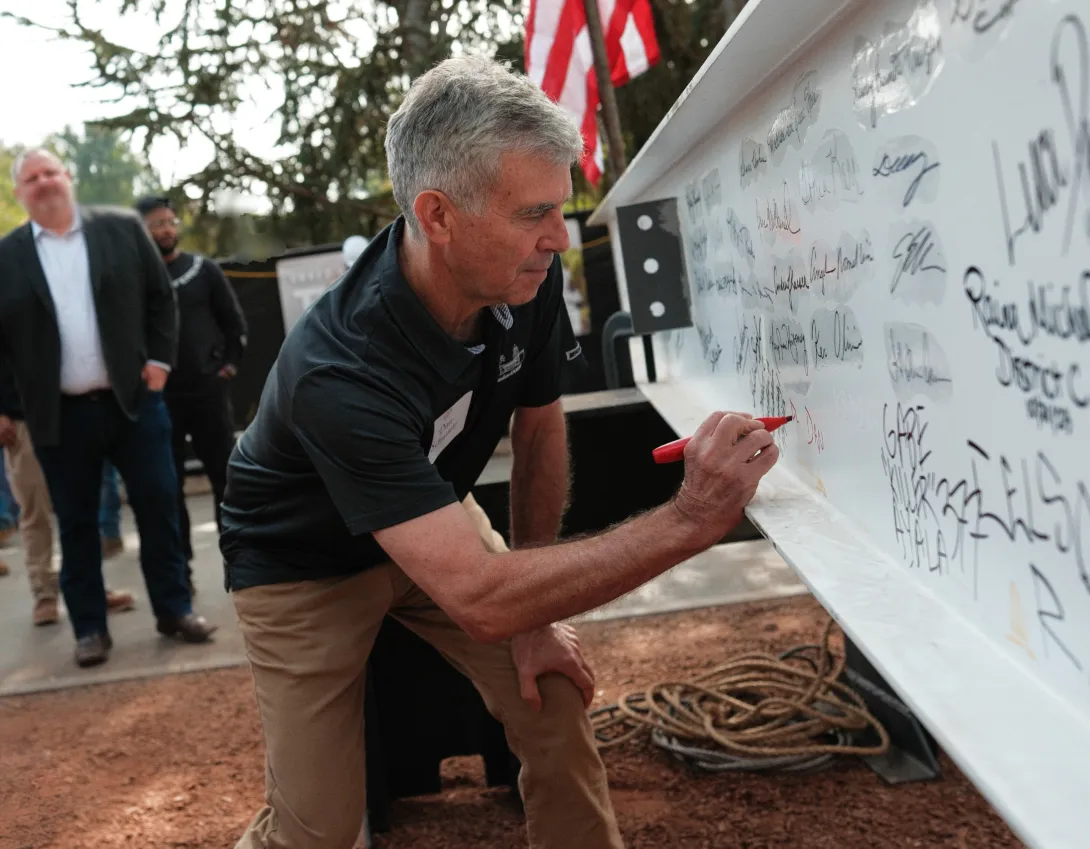
Dan Schwartz signing a construction beam of the new GSE buildings. (Photo: Ryan Zhang)
Perhaps the most visible change during Schwartz’s time as dean is the school’s physical space.
A major renovation of the GSE buildings, dedicated in November 2025, created a collaborative space for research, exchanging viewpoints, and learning. Students, staff, and faculty from across Stanford can now experiment in the AI Tinkery and GSE Makery. There are also several spaces for individual and team work. There are plans for a new research testing suite with equipment to help get a more precise understanding of how people learn.
“Dan led his faculty to transform the school’s research and education agendas and prepared the school for a future that will look very different from the past as education is being transformed by technology,” said Persis Drell, the former Stanford provost and professor of engineering. “I deeply appreciated how creative he was in the ways that he found to work with his fellow deans across campus for the good of the university as a whole.”
Expert on human learning
Schwartz came to Stanford in 2000, as an associate professor of education. An expert on human learning, he began the AAA Research Lab to innovate new ways for students to learn. For example, his team created a way for students to teach a computer character to reason about climate change.
Earlier, as a middle- and high school teacher in Alaska, Southern California, and Kenya, he tinkered with educational technology, eventually earning a master’s and PhD from Columbia University in human cognition with a focus on computers and education. His research has revealed new insights into how knowledge is formed and used to learn. He and his research partners have also investigated how movement impacts learning and creativity - from fidgeting to walking.
Schwartz, who holds the Nomellini & Olivier Professorship in Educational Technology, is co-author of an NPR best book, The ABCs of How We Learn, and has received multiple field prizes including the Klaus J. Jacobs Research Prize in 2021.
Faculty mentioned in this article: Dan Schwartz